
Unplugging the Classroom: How Smarter Tools Led To Weaker Minds
Feb 16, 2026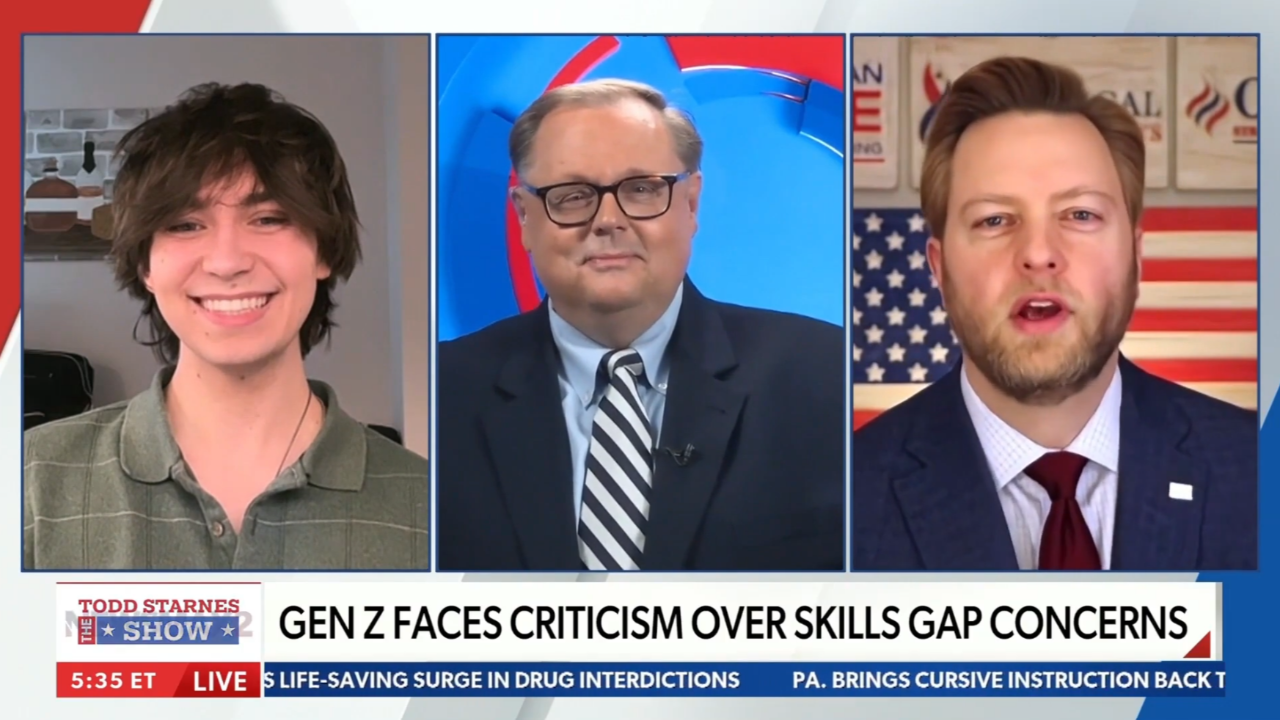
Byline: Dustin Olson, American Pulse
—
“Is Gen Z dumb?”
That was the question host Todd Starnes put to me recently on Newsmax.
It wasn’t a throwaway line. It came on the heels of Senate testimony from neuroscientist Dr. Jared Cooney Horvath, who told Congress something startling: Gen Z is the first generation in modern history to underperform their parents on nearly every cognitive measure—attention, memory, literacy, numeracy, executive functioning, even IQ.
That’s a big claim. And if you’re a parent, it hits hard.
My answer was simple.
No. They’re not dumber.
They’re distracted.
As pollsters, we spend a lot of time thinking about how messages stick with people. When someone hears a message and truly processes it, you can measure it. You can see it in recall. You can see it in behavior.
But when you’re not present—when you’re toggling between screens, notifications, tabs, and background noise—the message doesn’t stick.
That’s not an insult. It’s cognitive reality.
And increasingly, science backs it up.
The Neuroscience of the Pen
In recent research out of Norway, brain scans showed that handwriting activates far more elaborate neural connectivity patterns than typing does. Writing by hand engages sensory-motor systems, spatial awareness, and memory centers all at once. Typing, by contrast, is repetitive and uniform. Your fingers move, but your brain doesn’t map information the same way.
Put simply: when you write, your brain works harder.
And that’s a good thing.
Physical writing forces you to slow down. You can’t transcribe every word at lecture speed. You have to summarize. Prioritize. Think. That act of mental filtering strengthens encoding—the process by which information becomes memory.
This is what I meant when I told Todd, “When you’re not present and paying attention, the message doesn’t stick.”
Handwriting demands presence.
Typing does not.
Paper vs. Screens: The Recall Gap
The same pattern shows up in reading.
Research from Japan has found that people who read on paper not only complete tasks faster but show stronger activity in the hippocampus—the brain’s memory hub—than those reading on tablets. Paper provides spatial cues. You remember where something was on a page. You remember how it felt to turn to it. Screens flatten that experience. Everything scrolls. Everything looks the same.
Digital reading encourages skimming.
Paper encourages mapping.
There’s a difference between seeing information and internalizing it.
And if you’ve ever tried to recall a passage you read online versus something you studied from a physical book, you’ve felt that difference.
The “Google Effect” and the Illusion of Knowing
There’s another layer here.
We now live in a world where every answer is a click away. That feels empowering. But it also changes how the brain treats information.
If your brain knows it can retrieve something later, it is less likely to store it now.
Why memorize? Why internalize? Why struggle?
The tool begins to coddle the weakness.
And as Dr. Horvath told Congress, something happened around 2010. Schooling became decoupled from cognitive development. We didn’t change biology. We didn’t radically change buildings. We changed the tools.
We flooded classrooms with devices.
We replaced pencils with keyboards.
We replaced books with tablets.
We replaced focus with multitasking.
And we expected better outcomes.
Tie half your brain behind your back and scores drop.
That’s not a generational flaw. That’s a tool-driven one.
Presence Is the Missing Ingredient
When I said on Newsmax, “It’s not that they’re not smarter. They’re just not paying attention,” I meant that literally.
Presence is the gateway to memory.
Distraction fragments attention. And the mere presence of a smartphone—even face down on a desk—has been shown in other research to reduce cognitive capacity. You don’t have to be actively scrolling for your brain to allocate resources to the possibility that you might.
That’s the world today’s students are swimming in.
Not stupid.
Overstimulated.
The Case for an Analog Foundation
This isn’t an argument against technology. It’s an argument for sequencing.
Young brains need foundations.
Primary education should build attention, memory, discipline, and critical thinking before layering on digital tools that automate those functions.
Number two pencils are not nostalgic props. They are cognitive training devices.
Physical textbooks are not relics. They are memory maps.
We should not be surprised that when we outsource recall, summarization, spatial mapping, and even writing itself to screens, we get weaker recall, weaker mapping, and weaker writing.
If Gen Z is underperforming, it is not because of biology.
It is because of educational design.
The Pen Is Mightier Than the “Board”
When Todd joked about number two pencils, he was onto something.
The pen IS mightier than the “board”—and I mean keyboard.
If we want Gen Alpha and the generations after them to think clearly, reason deeply, and remember what they learn, we cannot continue to hand them tools that trade depth for convenience.
Slow down.
Put the pen back in their hand.
Give them a book.
And watch what happens.
📊 Join our new Polling Club community for more polling and insights on public opinion: PollingClub.com
GET YOUR OWN RESEARCH ROADMAP, STRATEGY SESSION, & QUOTE
Ready to gain a competitive edge? Submit the form below to begin the process of commissioning your own political poll and get at no obligation the following:
- Complimentary Research Roadmap, outlining the strategic insights essential for your success and how we would survey to get them
- Strategy Session with a Top Strategist & Researcher, offering expert analysis and tailored advice to achieve your objectives
- Special Discount on Your First Survey if you choose to move forward
Get Your Own Research Roadmap & Strategy Session Now—because optimal strategy requires transformative insights.
Want To Know the Headlines Before They Happen?
Join Polling Club to:
- Get exclusive polling
- Suggest questions to be asked in our public polling
- Decide topics we tackle in our public polls
Polling Club polls are public polls for media and polling club members and are different from internal surveys commissioned by clients. Also, don't worry, your information will never be shared.
We hate SPAM. We will never sell your information, for any reason.